
Smart Factories in the ISA-95 Era: How Machbase Neo Connects Data Flows
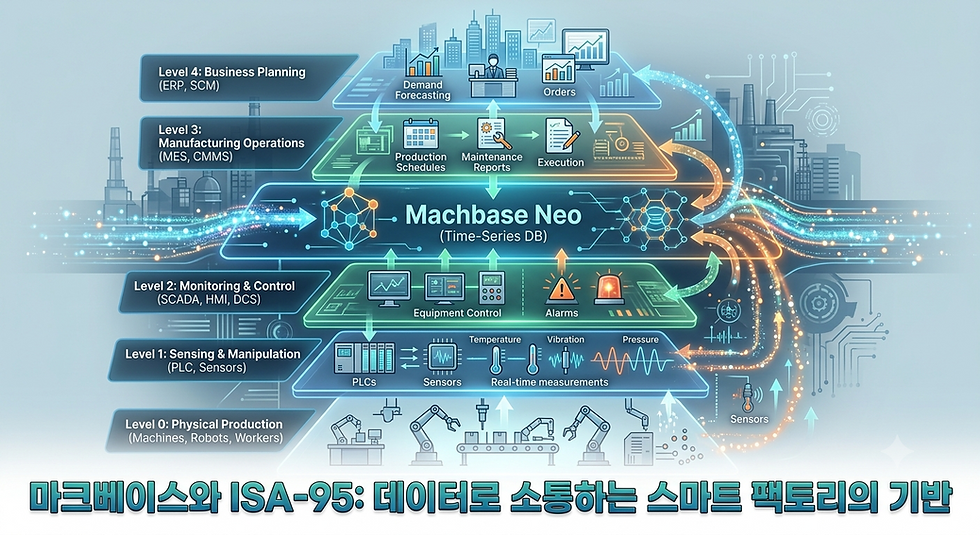
How does Machbase follow and put ISA-95 into practice?
Let’s step inside a factory.
Hundreds of machines run continuously, while their sensors generate temperature, vibration, pressure, and current readings every second.
When a production line stops, the person responsible checks PLC logs, examines SCADA displays, and compares them with the production results recorded in ERP to find the cause.
Yet one problem keeps coming up in this process.
The language spoken by equipment differs from the language understood by management systems.
If equipment on the factory floor, MES, and ERP use different names, units, and data structures even for the same term—“production volume”—a factory will struggle to speak with one voice, no matter how many sensors it installs.
ISA-95 was created to solve this problem.
Machbase, a company specializing in time-series databases, applies the standard’s philosophy to its products and data flows, helping different layers of a factory communicate in a common language.
This article explains what ISA-95 is and how Machbase follows and puts it to use.
ISA-95: A standard that divides a factory into five levels
ISA-95 is an international standard developed and maintained by the International Society of Automation (ISA). It is also known as IEC 62264 or ANSI/ISA-95 [1].
Developed in the 1990s on the basis of the Purdue Enterprise Reference Architecture (PERA), the standard has expanded into multiple parts since ISA-95 Part 1 was published in the early 21st century, establishing principles for integrating enterprise systems and manufacturing control systems [1].
Its official definition describes ISA-95 as a set of international standards intended to integrate logistics systems and manufacturing control systems [1].
It is also reported that more than 90% of manufacturers worldwide now use the standard to improve automation [1].
The core idea of ISA-95 is simple but powerful.
It enables different systems and software to communicate in a common language [1].
To achieve this, ISA-95 divides a factory into five levels, often represented as a pyramid [1].

At the bottom, raw data generated by machines and sensors at Level 0 passes through PLCs at Level 1 to become real-time measurements.
SCADA and HMI at Level 2 monitor and control this data, while MES at Level 3 connects it to production schedules and maintenance execution information.
ERP at Level 4 then connects it to demand forecasting, orders, and business planning [1].
MES specifically occupies Level 3 of ISA-95. Applying ISA-95 makes it possible to define the communication relationship between MES and ERP more clearly [1].
ISA-95 provides three core models on top of these five levels.
The Activity Model defines roles, activities, and interactions; the Object Model establishes a common language by standardizing definitions of equipment, materials, and personnel; and the Information Model addresses data flows, security, and access rules [1]. Together, these models improve traceability, scheduling accuracy, and quality management [1].
Why is ISA-95 attracting renewed attention?
One point is worth clarifying.
ISA-95 is not a newly introduced standard.
It has long served as a framework for integration in manufacturing. The reason it is attracting renewed attention now is the explosive growth of data.
As smart factories become more widespread, the number of sensors inside factories is growing rapidly.
With Industry 4.0 driven by the Industrial Internet of Things (IIoT), manufacturers can no longer postpone addressing communication and connectivity [1].
More sensors produce more data, but that data cannot deliver its full value if it remains scattered under different names and in different formats.
Organizing data in a standardized language is essential to real-time visibility and to extending consistent operations across multiple factories and regions [1].
This is where time-series databases play a crucial role.
Sensor data is inherently time-series data, accumulating in chronological order.
For the MES and ERP layers above to function properly, the large volumes of data generated every second or millisecond at Levels 0 and 1 must be collected without loss, compressed for storage, and made immediately available for queries.
Even a well-defined standard cannot readily deliver value on the factory floor without data infrastructure that allows data to flow in accordance with it.
Machbase processes the data that underpins the standard
Machbase focuses on precisely this area of data infrastructure.
The official Machbase website presents time-series database technology that has demonstrated world-leading performance in TPC benchmarks [2]. It also explains that Machbase can process rapidly growing data volumes in real time and compress data by up to 100 times without data loss [2].
The website also cites 11 years in business, more than 150 customers, and average daily processing of more than 100 billion data records [2].
Let’s look at Machbase’s role from an ISA-95 perspective.
The factory-floor layers at Levels 0 through 2, at the bottom of the ISA-95 pyramid, continuously generate raw sensor data and real-time measurements [1].
Reliably ingesting and storing that data is a core responsibility of a time-series database.
Machbase Neo (https://neo.machbase.com), Machbase’s IoT database server, supports both MQTT, through which IoT sensors can send data directly, and SQL over HTTP, through which applications can query that data [3].
It can be installed on devices ranging from a small Raspberry Pi to high-performance servers [3], enabling a consistent data layer from edge environments near the equipment to central servers.
Integration with external systems is another important feature.
Machbase Neo provides bridges to SQLite, PostgreSQL, MySQL, MS-SQL, MQTT brokers, and NATS [3].
This smooth exchange of data between layers is precisely what ISA-95 emphasizes [1].
Machbase provides standard interfaces that serve as pathways for sending time-series data collected on the factory floor to various systems in higher layers.
The combination of MQTT- and HTTP-based ingestion, bridges to higher-level systems, and data access through standardized metadata and dedicated APIs [2] aligns with the common language envisioned by ISA-95.
From the factory floor: Connecting Machbase Neo to MES
Let’s now look at a real manufacturing example.
The case involves Company M, a manufacturer specializing in automotive motors [4].
Company M wanted to build an equipment condition monitoring system by collecting production equipment data in real time [4].
To do so, it needed to collect data from multiple PLCs on each production line and monitor the condition of each line.
PLCs belong to Level 1 of ISA-95, the level responsible for sensing and manipulation discussed earlier [1].
The collected alarm and process progress data also needed to connect to the existing MES through an interface so that it could be viewed on MES screens [4].
From an ISA-95 perspective, the task was to reliably move factory-floor data from Level 1 up to MES at Level 3.
Machbase Neo helps explain the collection, storage, and transmission of data in this edge environment.
Machbase Neo is a high-speed time-series database server that supports MQTT and SQL over HTTP and can run on everything from small edge devices to high-performance servers [3].
In Company M’s case, an edge computing environment was built by embedding the Machbase time-series database in a total of seven edge devices deployed across the production lines [4].
Data initially collected and stored on the edge devices was configured to transfer automatically to a central server in real time [4].
This architecture helps reduce the loss of factory-floor data even during temporary network outages [4].
Alarm and process progress data required by MES was also configured to transfer from the edge devices through an MS-SQL interface [4].
As a result, the MES system could display alarms and progress data, allowing process conditions to be monitored in real time [4].
The accumulated equipment data could also serve as a foundation for quality analysis and predictive maintenance [4].
Mapping this example back onto the five ISA-95 levels makes the flow clearer.
Data generated by PLCs at Level 1 is stored in an edge data layer based on Machbase Neo and then passed to MES at Level 3 through an MS-SQL interface.
That data is then turned into process condition and predictive maintenance information that people can understand and use. This is a practical implementation of the data flows between layers defined by ISA-95.
Moving beyond following the standard to putting it to use
Machbase’s relationship with ISA-95 can be understood in two main ways.
First, it helps follow the standard.
Machbase ingests time-series data from the factory-floor layers through standard protocols such as MQTT and HTTP, then connects it to higher-level systems through bridges and interfaces [3]. This establishes a foundation on which different layers—factory equipment, data platforms, and MES—can communicate in a common language. It supports the interoperability required by ISA-95 at the data infrastructure level.
Second, it helps put the standard to use.
Machbase aims to provide a data architecture that goes beyond storage to handle analysis, applications, and operations together [2]. It offers an integrated solution stack covering data collection, transmission, storage, analysis, and visualization [2]. Machbase Neo includes TQL, a language for data transformation and visualization, and real-time dashboards as standard features [3]. Data accumulated within a standardized hierarchy can therefore be turned directly into insights for the factory floor. The foundation for quality analysis and predictive maintenance established at Company M [4] demonstrates the value of this practical use. Following a standard is not the end; it is the starting point for creating new value on top of it.
Closing thoughts: It begins and ends with data
As smart factories evolve, industrial sites continue to add sensors, collection intervals become shorter, and the volume of data that must be stored grows rapidly.
In this environment, ISA-95 serves as both a map and a common language, helping the different layers of a factory stay connected and oriented.
Machbase acts as the high-performance engine that processes and connects the data actually flowing across that map.
Machbase’s philosophy that “a company’s competitiveness begins and ends with data” [2] also explains why it follows and puts standards to use.
Even the best standard will struggle to deliver practical value if the data flowing through it is slow or inaccurate.
When fast, accurate data meets the framework of a well-defined standard, however, a factory can finally begin to speak a common language.
The way Machbase and Machbase Neo follow and apply ISA-95 is a process of making this communicating factory a reality.
References
#Machbase #machbase #ISA95 #ISA-95 #isa95 #TimeSeriesDatabase #TSDBMS #TSDB #Database #DBMS #IoT #Sensors #SmartFactory #Neo #MachbaseNeo #ShopFloorData #SCADA #PLC #ERP #MES #ANSI #ANSI/ISA95 #IEC62264 #ManufacturingData #HMI #TimeSeriesData #DataCollection #Level #LevelModel #IIoT #Industry4.0 #MQTT #NATS #HTTP


